Hiking Half Dome
At 4 am, Half Dome was still an idea in the dark. We stood at the trailhead with headlamps on, bags heavy with water and sandwiches, pretending the question was whether to pee one last time and not whether we were ready for the cables.
Half Dome at Yosemite National Park is a beast of a mountain. It is one of the most iconic and majestic-looking peaks humans are gifted enough to see. It is also a beast of a day hike. Stretching over 18 miles with a 5,000 ft elevation gain, it challenges most human beings physically and psychologically.
For the few who train on significantly harder hikes, it may be easy to scoff at these “trivial” numbers. You can empathize by assuming this is equivalent to you trying a medium-level challenge, with non-trivial risk, in a field you don’t dabble in.
Every serious hike eventually becomes a risk-reward argument with yourself. Your body has one opinion, your fear has another, your friends have a third, and the mountain does not care about any of them. Humans sit at varying points on this spectrum. We are also consistently inconsistent in our risk appetite across different domains. So having a good group of friends whose risk-reward alignment matches yours is important before undertaking a hike such as Half Dome.
Uttering the words “Half Dome” to a friend over the phone, actually, even thinking about it, is sufficient to get the social media ball rolling, where your entire feed gets filled with anecdotes, dangers, best practices, sad stories, and conflicting guidance about the hike.
The famous “cables” section is the final test. The last 400 ft of elevation gain goes straight up smooth granite, steep enough that your hands become part of your legs. Hikers can hook into the steel cables with harnesses and pull themselves up. But during the summer season, from late May to late September, the wonderful rangers at the park set up the cables so a hiker can do it without a harness, referred to colloquially as “the cables are up.”
Instead of a single long cable up the cliff, steel posts are added every 10 ft to create a walkway, with the cables at waist level. Every 10 ft, a wooden plank is also positioned across the steel posts to serve as a resting perch, instead of needing to stand on slippery granite. “Plank to plank” is the strategy hikers use to go up and down the cables.
The cables section in particular requires one to get a permit via lottery. We had applied in April for every weekend in the summer season. Out of several friends who applied, I was the only one selected in the lottery.
In a way, the cables get unfair coverage, though they are only about 40 minutes of a 14-hour hike. But perhaps rightfully so, because of the deaths that have occurred there. It serves as a true reminder of the nature of nature: graceful, beautiful, bountiful, serene, unforgiving, unfathomable.
Having done the Angels Landing hike at Zion National Park before, I knew I’d be able to handle the height and cliff face. That hike is a great litmus test for scarier adventures.
The cables are known to get crowded mid-day due to higher foot traffic. This makes navigating them more cumbersome, as there is heavy two-way traffic and a higher chance someone lets the height get to them and jams the cable traffic.
Another concern was the possibility of rain or thunderstorms at an elevation of 8,000 ft. Weather gets unpredictable. Even a short spell of drizzle is sufficient to make the granite super slick, changing the risk-reward ratio significantly. There were multiple warnings posted to abandon attempting the cables if there was even a chance of rain. Lightning strikes were also not uncommon and had to be accounted for.
Keeping the mid-day crowds and mid-day storms in mind, the best chance of ascending was earlier in the day. This meant that we needed to complete 8 miles by 10 am, requiring us to start the hike around 4 am.
In an interesting way, the energy of the sun controlled both human and cloud traffic timings. One alive, one non-living, yet the density of both visiting the summit of Half Dome co-occurs due to the deeper physics of the universe.
That meant we had to stay the previous night near the trailhead, so we could get an early start. We pulled into the park around 7 pm the night before, absorbing the bright pinkish hue of the horizon, enjoying the last arc of the setting sun whose final rays of orange splattered the summits of Half Dome and El Capitan.
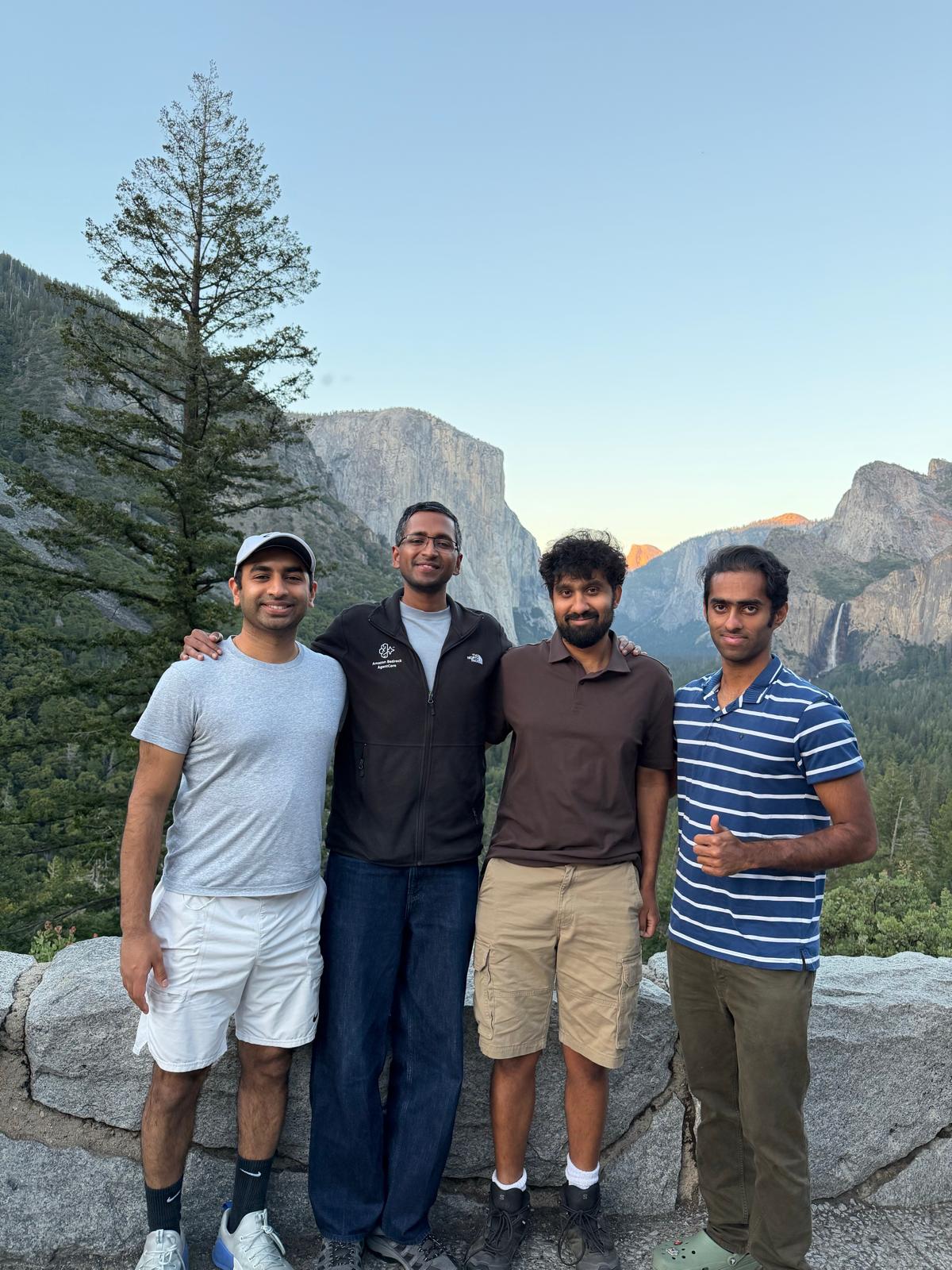 The park giving us one last calm view before the 4 am start.
At Tunnel View, we did a quick pit stop to soak in the view of Bridalveil Fall in the distance, faithfully flurrying down. We reserved a place at the Yosemite Condominiums, about 30 minutes away from the trailhead. The place was nicer than expected. It had self-check-in with a code, stable Wi-Fi, great running hot water, a kitchen, and beds. Importantly, there were also two bathrooms for four people, so that did not become a bottleneck.
We showered, prepped and packed sandwiches, filled our water bags, and tucked ourselves into bed by 9 pm. None of us had a habit of going to bed that early, so we spent some time on our phones, chatting about a baby black bear and a deer pack we had spotted on the drive, before letting sleep kick in. The fear of needing to wake up at 3 am occluded the fear of the cables.
Surprisingly, we were all up at 3 am. We freshened up, picked up our bags, and were at the trailhead by 4 am. After the usual dilemma of whether to pee or not to pee at the trailhead restroom, we started briskly walking with our headlamps on.
We crossed Vernal Fall about 40 minutes in. I was so excited to revel in the mist and splash the falls was sharing with me. Perhaps a blessing for the hike, perhaps a warning that the path had danger and to tread with care, perhaps a reminder to allay my fears and induce me to enjoy the movement one step at a time.
We then hiked up Nevada Fall with fair energy. LMNT-spiked water served as a refreshing drink during the breaks. After that, we hiked for some time on flatter ground at Little Yosemite Valley campground. The view cleared up, and we could then spot Sub Dome, and right next to it, Half Dome. It seemed like a whole new hike started from there. The summit seemed precipitously out of reach.
Surprisingly, from that viewpoint, the Sub Dome elevation gain seemed much steeper than even the cables section. Before the elevation started again, we decided to get some proper food into our system with granola bars and sandwiches.
On our way there, multiple folks greeted us as they passed by, as is common hiking etiquette. But here, some of them would also stop and ask if we had extra spots on the permit to be able to summit Half Dome. About a third of the people on the hike to Half Dome did not seem to have a permit to reach the summit that day.
Quite a bold decision, I would say, given that they were willing to put all this effort in with a high chance they would be turned back at the Sub Dome section by a ranger, unless, on the off chance, someone else had an extra permit or some permit holder did not show up to the hike. We noticed several fellow hikers hanging out by the ranger station at Sub Dome for hours before being let through.
The trees started to give way, and we were clearly above the treeline, with the early sun striking and heating our heads and backs. There was a beautiful half moon setting exactly along the Half Dome mountain line. Along with the bright blue cloudless sky, the fading green, and the gray steep rock close and afar, it became one of those visuals you never forget because it becomes a core memory.
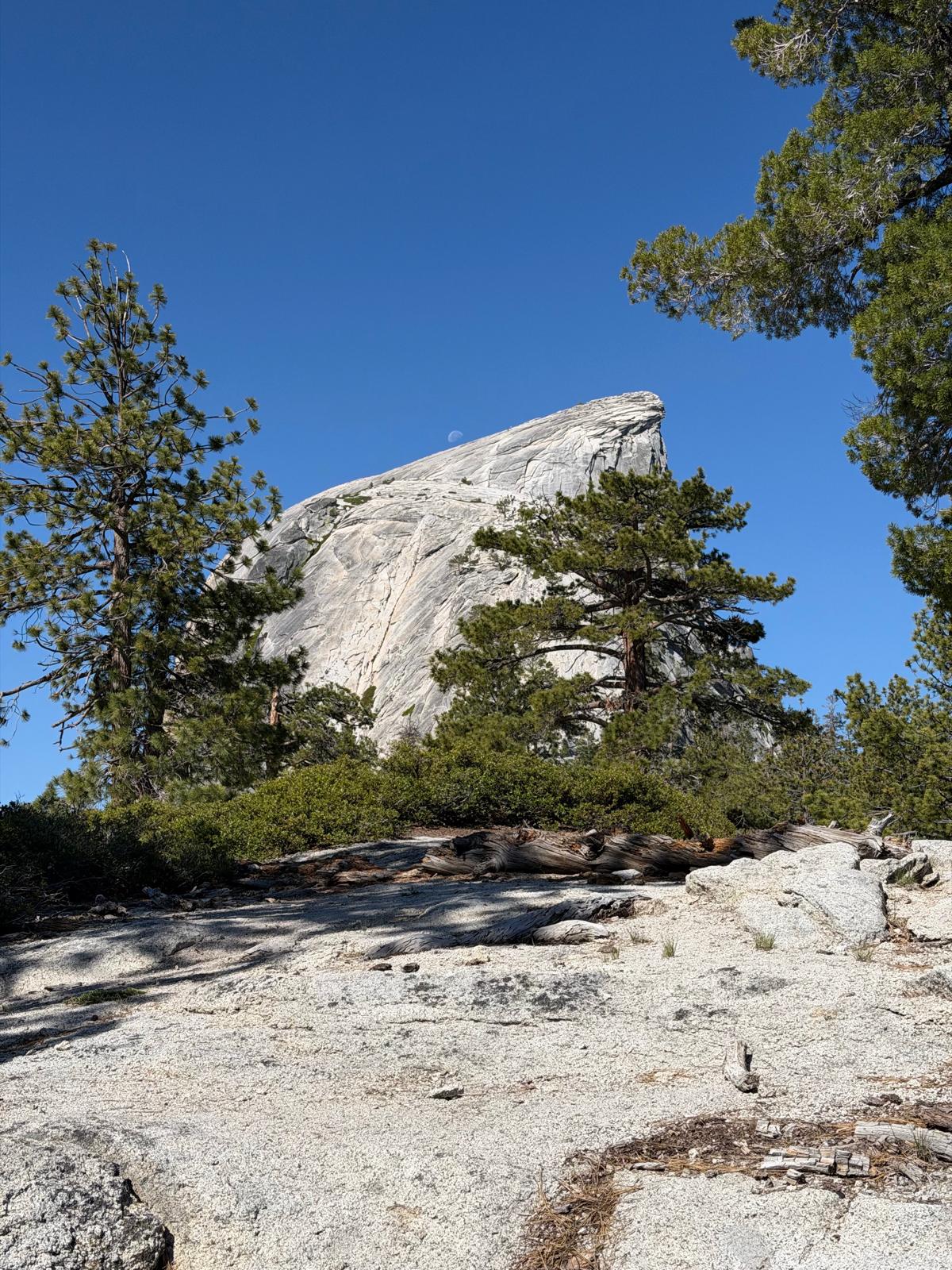 The half moon holding its line over Half Dome.
A memory you hold on to and think about during hard times, but also during easy times, busy times, relaxed times, alive and almost-not-alive times.
The ranger station grew closer. It was essentially a desk and chair placed under the last section of trees on the hike, to get some shade. We decided to catch our breath under the shade before the upcoming incline of insanity. We showed our papers to the cheerful rangers, who showered us with confidence and shared some insights on the Sub Dome and Half Dome sections.
“Sub Dome is physically tougher; Half Dome is mentally tougher” was the key item to remember.
We started the steep Sub Dome ascent. Though it had high elevation gain, the rock face was cut into steps and had good holds. The exposure on the sides is threatening to look at and think too much about, but at no point are you not on stable footing.
With heft and heaving breath,
we took step after step after step,
only the summit stop we shall accept,
to enjoy the god-gifted view that is perfect.
We stood on the summit of Sub Dome, and the cables finally came into clear view. This is the decision point where many hikers make the choice to stop the hike, enjoy the view, and return. It is the same spot where thrill seekers decide to carry on with the cables to reach the top of Half Dome. A spot once considered out of reach of humanity, only for the statement to be rendered false in a few years.
Another decision the thrill seekers make is about the use of harnesses. Many people do use harnesses, but they significantly slow down the line from moving, as people need to connect and disconnect every 10 ft to attach to the next rung. Important disclaimer: people should plan for their safety however they deem fit.
We decided to not use a harness and instead use good grippy gloves. Though a harness feels safer on paper, many hikers don’t bring the proper type of harness setup, such as via ferrata gear, or don’t have good experience hooking and unhooking, which can divert attention away.
Aside: I had not used a harness outside this before. The only harness I have great experience working with is the modern AI agent harness in the field of software engineering that attempts to drive an LLM. A throwback to my work.
It is important for each person to make a determination based on their risk appetite, mental state, and preparedness before deciding whether they want to continue to the cables or not. It is absolutely fine for someone to make it all the way to Sub Dome and not do this part as well. We wanted to ensure that we did not peer pressure anyone into doing it, so we went around asking each other if we were comfortable continuing or not.
Closely following the “plank after plank” strategy, we reached the top of Half Dome about 30 minutes from Sub Dome. The first few planks were the loudest in my head. Glove on cable, shoe on granite, breathe, move. The trick was to reduce the mountain into ten-foot increments. Do not look at the whole face. Do not negotiate with the drop. Just reach the next plank and let that be the entire universe for a few seconds.
There was some crowding on the cables due to two-way traffic. Some folks also freeze in fear and get stuck at a plank. The height gets to their head, and they cannot move up or down. It is important to not let the situation get too much into your head as well, and to keep breathing.
We spent a good 40 minutes at the summit, exploring the various viewpoints. Yosemite Valley looked pristine as ever. El Capitan stood tall and incomprehensible as ever in the distance. The rushing force of Upper Yosemite Fall was a beautiful sight to see.
I had hiked up the tallest free-falling waterfall in North America, Yosemite Falls, a few years ago. But that summit seemed far down compared to where I was now. The scale of power and time required for glaciers to carve immovable rocks over millennia still astounds me. That scale is what makes you feel tiny in the cleanest possible way. Maybe that is the closest our senses can get to divinity: rock, water, time, and the sudden awareness that we are briefly passing through.
After taking copious amounts of photos so as to not erase proof of summit, we decided to head back down. Going down the cables is usually riskier than going up. The smooth granite is ever so deceiving, and it is important to not let complacency set in at any point. The usual advice is to climb down as you would a ladder, facing the rock and not facing down.
We all safely made it down to Sub Dome and decided to have our second set of packed sandwiches. This time, the meal tasted better, sweet from the accomplishment of going up and down the cables.
Lunch also attracted a squirrel we nicknamed “Chonkers,” who wreaked havoc on our brief rest. It tore a hole through my friend’s bag and burrowed into a Ziploc pouch filled with protein powder. White streaks dotted the steep granite, forming a trail that ended at Chonkers’ sharp incisors and comically puffed cheeks.
The high of summiting, along with re-doses of LMNT-infused water, kept us going until Little Yosemite Valley. This is when Half Dome collects its final payment. The summit high fades, the muscles become honest, and the remaining miles to the car seem to multiply.
To spice things up, we decided to split our group of four into two sets and race to the parking lot. The winner would get their dinner sponsored. Big stakes, since this was going to be a post-hike ravenous meal.
There are two trail options after Little Yosemite Valley to the parking lot: the John Muir Trail, or JMT, and the Mist Trail. The Mist Trail is the one we had taken on our way up and goes through Vernal Fall, where you will get fully wet. More so in the late afternoon, because the sun melts the glacier faster and gives more to the waterfall.
I definitely wanted to do the Mist Trail again, but another friend wanted to keep himself dry and do the JMT. JMT is also a bit longer but gentler on the knees. One key piece of advice, if anything, is to please carry hiking poles. The return on investment for 20 bucks on your knees is asymptotic. Because we made good use of hiking poles, I was willing to go down the steeper Mist Trail again and have some fun with the spray.
We split up and tried racing to the parking lot. My friend and I made it to the trailhead in record time. We enjoyed the spray from Mother Nature along the way. The Mist Trail is super popular during the summer season and is filled with fellow national park tourists, so it did take some maneuvering to keep a good pace.
There was not much signal during the trail, but as we reached the trailhead, we overheard some folks talking about how the JMT was closed and they had to turn back around. So things did get interesting, but unexpectedly, because the other set of friends had embarked on the JMT down for 20 minutes only to realize it was closed, and then had to double back up to join the Mist Trail.
We regrouped back at the car and decided we could not declare a winner because the JMT was closed. We decided to drive back the same evening to the Bay Area to save on spending another night at a hotel.
We stopped by this great dinner place at Buck Meadows, about 45 minutes from the park, called Lucky’s Cafe. The place also had a fast charger for our electric vehicle. It had a ton of options with good variety to satisfy the group’s eclectic opinions.
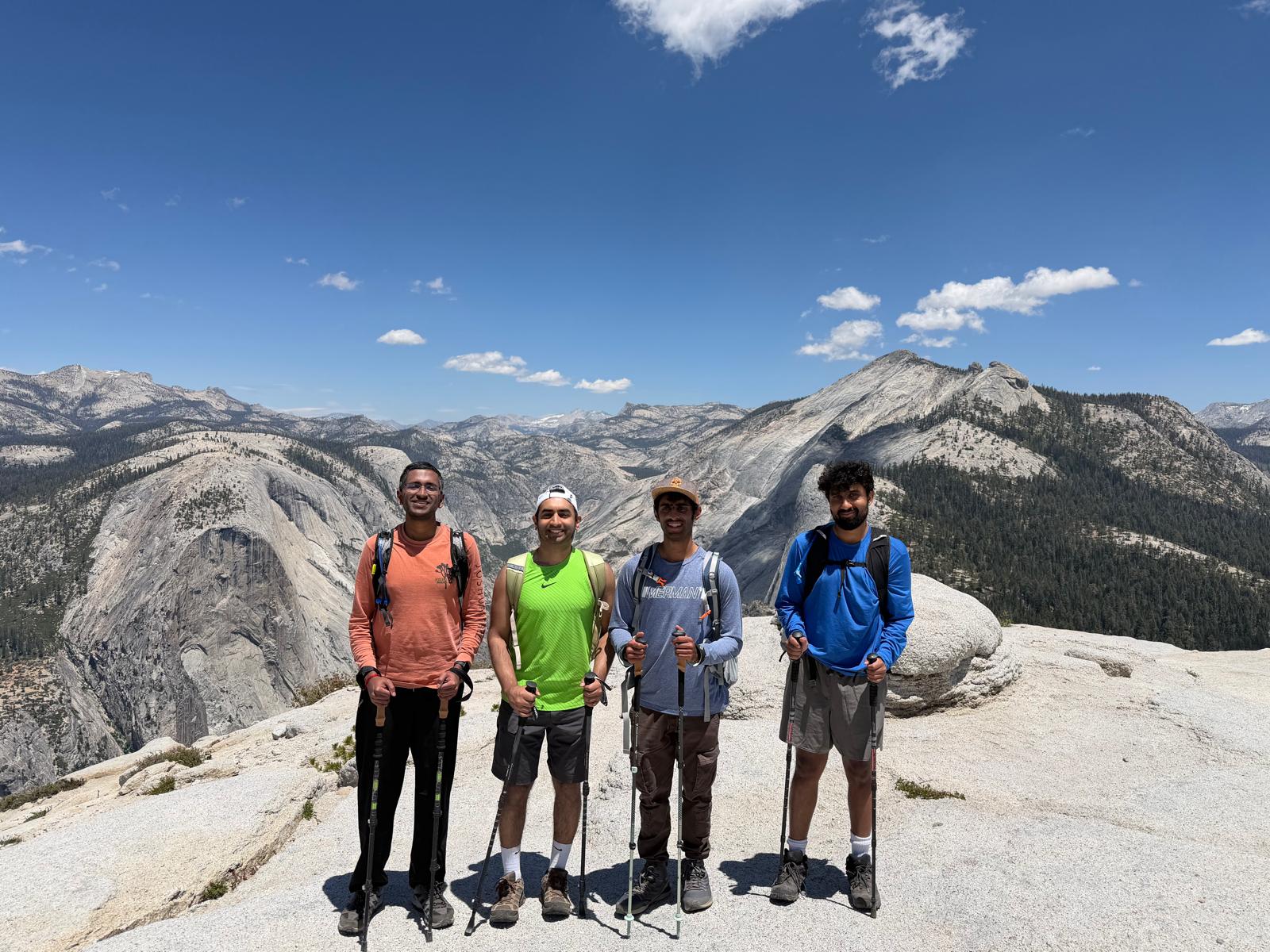 The official post-hike refueling ceremony.
As we made our way home, I could not help but fall asleep in the car. My mind, heart, and stomach were all full. We showered and hit the bed to a great sleep, but not before I said a prayer of thanks to nature and the world.
Somewhere between the mist of Vernal Fall, the steel of the cables, and the half moon over granite, the day had emptied me out and filled me back up. I fell asleep thankful: for friends, for knees that held, for nature that allows us to escape into it and return changed.